| FIRE TRUCKS AT WAR |
| Fire Apparatus built by the Motor Transport Depot, Camp Holabird, Baltimore, Maryland, 1925-1942 |
| Standard Pumping Engines |
| Camp History |
| U.S. Army activity at Camp Holabird began in December 1917 with the purchase of 96 acres of land on Colgate Creek, in the southeastern section of Baltimore City, approximately 6 1/2 miles from downtown Baltimore. The first Army unit to locate there was the 306th Mechanical Repair Shop, Quartermaster Corps. The following year the post was named "Camp Holabird", in honor of Brigadier General Samuel B. Holabird, Army Quartermaster General from 1883 to 1890. Camp Holabird was the Army's first large motor vehicle base. During 1919, Camp Holabird served the Motor Transport Corps in the following capacities; Repair and rebuilding of motor equipment, storage of motor equipment, storage of repair parts, training school for mechanics and operators of motor equipment and housing of personnel to operate the camp. During WW I, Camp Holabird was the receiving and shipping point for all automotive transportation equipment and spare parts to the American Expeditionary Forces in France. It was also the training and organization point during the war for all military transport units and thousands of drivers, mechanics and transportation experts stationed there. Camp Holabird also maintained a driving course for testing new vehicles. After World War I, important automotive transportation work was continued at Camp Holabird. In 1920, the installation was renamed "Holabird Quartermaster Depot". |
| Fire Apparatus |
| Prior to 1925, the Army had little fire fighting apparatus and that which it had was homemade or standard commercial equipment procured locally by individual post. Several large orders of apparatus were placed during WW I from Ahrens-Fox, Howe, Seagrave and American LaFrance, but the majority of fire apparatus was still procured locally. Getting parts when breakdowns occurred became a problem with so many types of equipment in service at so many posts spread throughout the country. In 1925 the Army decided to began building it's own fire apparatus. This decision was made for two reasons, first, it was cheaper to build it's own using surplus WW I truck chassis as basic elements, second, it would keep all it's Army trucks standardized, allowing parts to be obtained from the post motor pool when a breakdown did occur. The personnel at the Holabird Quartermaster Depot were given the task of designing the new fire truck. Since many of the WW I "Liberty Truck" chassis, which had preformed so well in France were still in storage at Holabird, it was the logical choice in which to construct the new fire truck. |

| First type of pumper built by the Holabird Transport Depot. This rig served at Camp Meade, MD |
| The first version of the Holabird built fire truck was constructed in July 1927 on the "Standard B" Liberty truck, 3-5 ton chassis. Full front fenders and running boards were added and a 400 gpm rotary gear pump was mounted midship on the vehicles chassis. An open hose body was affixed to the chassis just behind the pump. Various fire fighting tools and appliances, hard tubes and ladders were mounted. The completed fire truck was known a Class BF Fire Pumper. The letters USA were cast into the upper portion of the radiator. This first series was manufactured until 1932 and it is unknown how many were produced. FTAW has been able to document about 15 of these early rigs. |


| Class 510 Holabird Pumper USA 5059 Aberdeen Proving Ground FD |
| The second version of the Holabird fire truck appeared in 1932. It was more modern in appearance then the earlier truck. It was constructed on the 3rd series Standard B, a 5 ton chassis. The second version was equipped with a 6 cylinder, 105 hp Continental engine. It featured contoured fenders, pneumatic tires and duel rear wheels. The vehicle was now equipped with a two-stage 500 gpm. pump and it carried 150 gals of water. !50 ft. of 1 in. hose was carried in a basket mounted over the fire pump. It was equipped with a tools and appliances needed for structural fire fighting. It was know as the Class BF 510 and some 35 of these rigs have been documented by FTAW. |
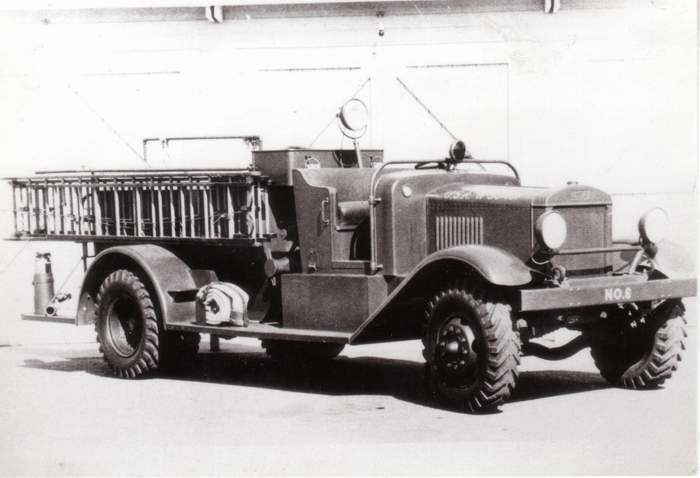
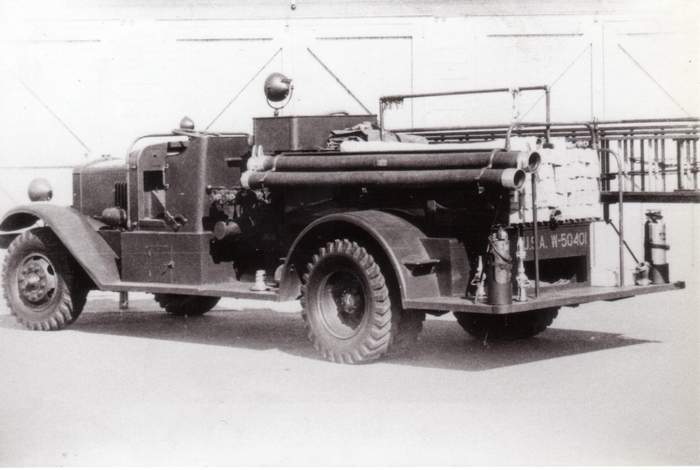
| 1941 Class BF 750 Holabird Pumper USA 50401 Aberdeen Proving Ground FD |
| The third and final version of the Holabird fire truck appeared in 1938. It also used the Contiental engine and was equipped with a single stage 750 gpm. pump. The letters USA were cast onto the upper portion of the now one-piece radiator. It was even more modern in appearance and sported large military type tires. A chrome handrail was also fitted to the entire engine cowl. All versions of the Holabird pumper were of open cab design and none were equipped with windshields. It was equipped with a 150 gal. water tank and 150 ft. of 1 in. hose was carried in a basket mounted over the fire pump. The hose bed could carry 800 ft. of 2 1/2 hose. The final version of the Holabird pumper was know as the Class BF 750. Research by FTAW has been able to document some 100 of these rigs. |
| With the onset of World War II the production of the Holabird pumper came to a end. The Army's need for fire apparatus was far greater then what the Quartermaster Depot could supply. Commercial truck and fire apparatus manufactures were mobilized by the government to meet the needs of the Army for fire equipment. These manufactures built over 8500 fire engines of every type for the Army's war effort. |


| Nomenclature plate from Holabird Class BF 750. USA 50298 Built 10 Feb 1941 Morris Army Airfield, N.C. |
| Nomenclature plate from Holabird Class 510 USA 50314 Built 1940 Fort Warren, WY |
 |
| |
 |
| |
 |
| |
 |
| |
 |
| |
 |
| |
 |
| |
 |
| |
 |
| |
 |
| |
 |
| |
 |
| |
 |
| |
 |
| |
 |
| |
 |
| |
 |
| |
 |
| |
 |
| |
 |
Nelson Dionne Collection
Nelson Dionne Collection

| Nomenclature plate from Holabird Class 750 owned by the Woodlawn Vol FD in Maryland. USA 50203 served at the Richmond Army Airbase, VA during the war Build date 29 Apr 39. |

| Holabird BF fire trucks at Fort Sill, March 1930 |